


Oogy Wawa!!! How to Say “Cheers!” in 51 Different Languages.
October 10, 2011
The very first record of “Cheers!” can be found in the 18th century as a shout of encouragement or support. Nowadays it has many different meanings, depending on which context it’s used in. As a toast, cheers became from “Good Cheer” in the early 20th century. Us English? Well, we just say Cheers as a form of thanks. Believe it or not, cheers is one of the most used expressions around the world, so who doesn’t need to say “Cheers!” in 51 different languages!?!?
Afrikaans : Gesondheid! : (Ge-sund-hide)
Albanian : Gëzuar! : (Géschuar)
Arabic (Egyptian) : في صحتكم! : (Fee-sa-ha-tak)
Azerbaijani : Afiyët oslun! : (Afeeyet Ohs-lun)
Basque : On egin! : (On egín)
Bosnian : Živjeli! : (Zhee-vi-lee)
Bulgarian : Наздраве! : (NAZ-dra-vey)
Chinese (Mandarin) : 乾杯! [干杯!] : (Gan BAY)
Chinese : (Cantonese) : (Gom bui)
Czech : Na zdravi : (NAZ-drah vi)
Croatian : Živjeli! : (ZHEE-vi-lee)
Danish : Skål! : (Skol)
Posted in Facts, Funny | Tagged Cheers, Say Cheers in different languages | Leave a comment //This Week In Wine-10/9/11
October 9, 2011
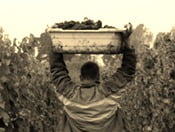
Hand-Picked Grapes ‘Compulsory’ for Burgundy Wine
The makers of the most expensive Burgundy wines have changed the rule book to make grape-picking by hand compulsory in bid to defend the region’s age-old traditions.
The domains, who say machines damage taste and are bad for vines, want other top Burgundy wine makers to follow suit, in view of a total ban in the region by 2014.
For the past fortnight, thousands of seasonal workers have been toiling under the autumn sun to pluck precious pinot noir grapes destined for Burgundy’s top quality red wines, its grands crus, using methods little changed since Cistercian monks cultivated the land 1,000 years ago.
Click here for the full story.
My Thoughts
Of course; picking grapes by hand fulfills the romantic image most people have of a vineyard, but is it practical for all wineries? Some think that harvesting by mechanical-means can have a negative effect on the vineyard by compacting the soil, and polluting it with chemicals etc. Tradition is one thing, but I would like to see whether anyone can spot a difference between the two methods in a blind tasting. I very much doubt it.

Marijuana Wine: The ‘Open Secret’ Of Wine Country
Pot brownies are so yesterday — who cares about accidentally getting co-workers high or police eating confiscated pot brownies? What about the next big pot-and-food trend: marijuana wine.
Adjusted for volume, “special” wines can range from under a pound of marijuana per 59-gallon barrel to over 4 pounds per barrel. The result is a spectrum ranging from a gentle, almost absinthe-like effect to something verging on oenological anesthetic.
Good wine deserves to be paired with good food, so perhaps a dish using homemade cannabis flour is the perfect match. Want something a little more exotic? Try bhang ki thandai, mad’joun or mie aceh, dishes from India, Morocco and Indonesia that all incorporate weed.
Click here for the full story.
My Thoughts
Holy hell!!! Who knew!?!? Best kept secret of the wine industry is right!!! Where can you find this stuff!?!? It would sell like….well….wine that’s been infused with marijuana…!
Posted in News | Tagged Burgundy, French Laundry, Marijuana, New Zealand | Leave a comment //
Chateau Ksara Blanc de Blanc-A Wine from Lebanon
October 7, 2011
Grape
50% Sauvignon Blanc, 25% Chardonnay, 25% Semillon
Facts
-
That’s right, I said it! Lebanon!!!
When you think of the top wine producing regions in the world, Lebanon most likely isn’t a part of that list. However; the fact that the country can even produce wine in such a place so torn apart by war, is nothing short of an absolute miracle!
-
Believe it or not, Lebanon is actually one of the oldest sites of wine production in the world! Winemaking is thought to go back about 6000 years!
-
There are two kilometers of Roman passages running underneath Chateau Ksara, which they actually use as the winery’s cellar. How resourceful!
Vineyard-Surface in Germany Infograph
October 7, 2011
Wine in Plastic vs. Glass – Another New Wine Debate!
October 6, 2011
Ahhhh, yes! Just what we need! Another long and tedious argument relating to wine packaging!
I came to terms a long time ago with the fact that if I had to read another article on “cork vs. screwcaps”, I would probably just stab myself in the eye with a corkscrew.
I’ve therefore been ever-so-feverishly searching for the next big argument! Since the next debate that I predict will be wine in glass vs. plastic bottles, let’s take a quick look at the potential advantages and disadvantages of each.
Advantages
Weight
A plastic bottle has around 1/8th the weight of a glass bottle, therefore making transport more efficient. It doesn’t sound like a big deal, but if you’re transporting wines from New Zealand to the U.S., that can mean a considerable amount of fuel saved overall.
Refrigeration
Since the walls of the bottle are thinner, the white wines typically chill much faster. This is a BIG advantage, for me at least…but I’m inpatient anyway…
Breakability
Plastic doesn’t, glass does; break that is. Obviously, this makes them easier to handle and transport. More importantly though, it also means you can take your wine “pool-side”!
Environmental
Plastic wine bottles typically produce around 29% less greenhouse gas emissions (GHG) over the entire lifecycle of the product compared to a 750ml glass bottle. Plastic bottles are arguably more recyclable, but the question remains about the “real world” recyclability of plastics. Just because it’s recyclable, doesn’t mean that it will be! However, that’s another even more boring debate, which I definitely won’t be getting into here. You’re welcome!
Posted in News | Tagged Cork, Plastic wine bottles, Screw Cap, Screw Cap Wine, Tetra Pak, Wine Packaging | Leave a comment //I Can Haz Wine?
October 6, 2011
← Older posts Newer posts →
-
Archives
- June 2014
- April 2014
- March 2014
- February 2014
- January 2014
- December 2013
- November 2013
- October 2013
- June 2013
- May 2013
- April 2013
- March 2013
- February 2013
- January 2013
- December 2012
- November 2012
- October 2012
- September 2012
- August 2012
- July 2012
- June 2012
- May 2012
- April 2012
- March 2012
- February 2012
- January 2012
- December 2011
- November 2011
- October 2011
- September 2011
- August 2011
- July 2011
- June 2011
- May 2011
- April 2011
- March 2011
- February 2011
- January 2011
- December 2010
- November 2010
- October 2010
-
Meta