


A Quick Soiree with Andrew Lazorchak.
November 16, 2012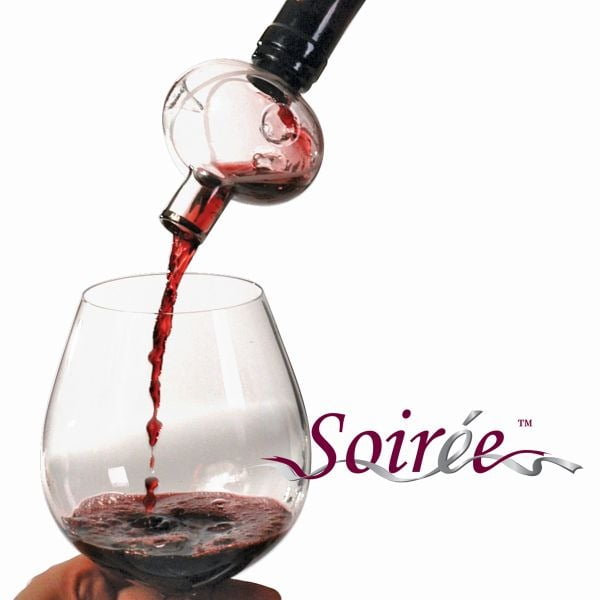
What is your position with Soiree?
I am the co-owner and managing partner for SoireeHome.
 How did you come to be involved with Soiree?

Soiree was conceived of over a few different nights at a wine bar that I designed for my, now, business partners but prior long time family friends. I was an architect at that time, with a focus on architectural branding. After some discussions at the wine bar and looking at all the wine paraphernalia one acquires when they have a wine bar in their house, we thought it may be fun to get into the business!
So, at first I was just thinking I would make a portfolio piece to showcase packaging design, branding and light product design. After sniffing around and kicking the tires, we decided to give Soiree a test run. That was 2006-2008. We launched officially at the Boston Wine Expo in Feb 2008. With a lot of hard work, we found ourselves as a known accessory to the wine industry and we eventually became rooted in the Housewares Industry.
 Can you aerate anything with the Soiree i.e. white, red, Champagne?
No you cannot aerate anything. Sparkling wines shouldn’t be aerated, unless you like a bubbly mess on the ceiling and floor!
Whites and reds can both be aerated, but one must play detective and see what characteristics have unfolded when the wine is aerated and when it is not. This way you can determine what is best for your palate.
Port opens up wonderfully when aerated. Cognac, Pisco, and any other spirit from grapes will benefit from the Soiree. While aeration does nothing for the chemistry of spirits, when aerated spirits will taste smoother on the palate and the back of the throat. So while the spirit may taste smoother, the aeration effect is not to be compared with how wine is effected. Soiree has been used by professionals on bourbon, tequila, vodka etc, but it is not an avenue we have elected to market.
Are there any types of wine you shouldn’t aerate?
Yes and no. It’s really more a question of how wine geeky are you.
 I’m very wine geeky….but in a good way…
Ok, my blanket statement is: the lighter the color and body of the wine, the less air it can handle and less it will benefit with aeration. For example; younger hearty reds (Zin, Syrah, etc) can be aerated without hesitation. Lighter Pinot Noir or Gamay may only benefit with a bit of air, before their body / structure starts to fade.
Whites wines can be aerated, but again if they do not have a good structure or acidic backbone, they should be watched carefully that they are not over-aerated. White wines will see heightened aromatics when Soiree’d, and the Soiree is a great way to get the oak in white wine to blow-off or integrate.
Aged wines usually will fall apart if they get treated roughly, but I have tried Soiree on 14 year-old wine from a magnum, and it actually helped recompose the wine. Soiree took a damp brine-y nose and brought in some light cranberry and leather notes. It really depends on the wine is holding up in the aging process. In general, if an older wine tastes good, I would let it be. But any wine I find to have an over pronounced character or flavor profile, Soiree usually helps the wine present and balance out.
Posted in Interview | Tagged aerating wine, Aerator, Andrew Lazorchak, best wine aerator, best wine decanter, Soiree, Soiree Home, Soiree wine aerator, wine aerator | 2 Comments //Not Sure How to Choose the Right Turkey for Thanksgiving? This guide can help!
November 16, 2012Courtesy of Whole Foods.

Everything You Should EVER Need to Know about Beaujolais and Beaujolais Nouveau.
November 15, 2012
What is Beaujolais?
Beaujolais [Boe-zjoh-lay] is a red wine made from a grape called Gamay. Yup! That’s where we already hit our first hurdle! There is no Beaujolais grape, contrary to what most people assume Beaujolais to be made from. This is always where consumers get confused, not just with Beaujolais, but with French wines in general i.e. between the grape and the region the wine comes from.
By French law, Beaujolais Nouveau is to be released no earlier than the third Thursday of November. Beaujolais must also come from the Beaujolais region, in the Southern part of the Burgundy region of France.
 Is Beaujolais made any differently than other wines?
Beaujolais Nouveau is made in the same way as regular Beaujolais, just a little quicker. The wine is normally ready to be poured down your kitchen sink…<ahem> I’m sorry! Did I say that out loud!?!? I don’t know what came over me!?!? Where were we?…In the case of Beaujolais Nouveau, the wine is “ready to drink” within 2 months of starting fermentation, (usually released on the 3rd Thursday in November every year).
There are a couple of different ways to produce Beaujolais, but they are all roughly based around a winemaking technique known as carbonic maceration. Carbonic maceration isn’t strictly reserved for the production of Beaujolais wine, but it also isn’t used too widely around the world.
Now, don’t get scared! I know carbonic maceration sounds all “wine sciencey and nerdy”…but…well…yeah, it’s VERY wine sciencey and nerdy, but a basic understanding of the process is critical to understanding Beaujolais.
- Carbonic maceration involves placing whole bunches of grapes in huge cement or stainless steel tanks which have had the oxygen removed.
- The weight of the grapes crushes the grapes at the bottom of the tank.
- Fermentation begins.
- Fermentation produces carbon dioxide, which in turn makes the enzymes in the grapes essentially attack itself and breaks the grape down further.
- This process is allowed to continue for 5-15 days and produces only about 3% alcohol in the wine.
- After this, the vat is drained, the fermented juice is separated from the skins, and the skins are pressed in order to extract tannin (but not much).
- The wine is then allowed to run a 2nd fermentation to raise the alcohol level, and to “smooth out the edges” on the wine.
 The History of Beaujolais
Beaujolais Nouveau was first produced in France during the 1930’s, but really first came onto the world stage in the 1980’s via well-known French winemaking chap going by the name of Georges Duboeuf. Mr. Duboeuf was a winemaker who obviously had a keen eye for making a profit, (selling wine a few weeks after its harvest is GREAT for keeping your accountant off your back!)
During the 60’s and 70’s he established a series of races in France to determine who could get the wine from the Beaujolais region to Paris the quickest. The rest of Europe and North America took up the challenge during the 80’s.
Some argue (mainly tree hugging hippies) that the speed at which Beaujolais producers get their product to the consumer is a concern, this since wineries around the world have been making huge efforts to reduce their “carbon footprint” on the environment. A bottle of Beaujolais Nouveau, it has been said, bears 4 times the carbon footprint than a regular bottle of wine. For this reason, Duboeuf within the past couple of years has made the decision to start shipping their wines by boat rather than by plane. Presently, George Duboeuf still remains the biggest producer of Beaujolais Nouveau.
 So how long can you keep Beaujolais/Beaujolais Nouveau for?
Beaujolais Nouveau should be consumed within 6 months of being bottled. Why you ask? Well, as mentioned previously, Beaujolais Nouveau tends to be lacking in tannins, and tannins give a wine the ability to age well. No tannins = less graceful aging.
Therefore, that bottle of Beaujolais Nouveau you’ve had collecting dust on your kitchen counter since last Thanksgiving…I hate to break the news, but it’s most likely dead.
Regular Beaujolais and Beaujolais-Villages (not Nouveau) should be consumed within 2 years of the vintage date on the bottle. Cru Beaujolais (we’ll get to that in a hot minute) is usually safe up to 3 years, but some can even last to 10 years depending on the vintage.
 So does all Beaujolais suck?
Beaujolais has always been given a tough time by its critics…mainly because it’s an easy target!
French wine critic François Mauss was famously quoted as saying the reason for declining Beaujolais sales, was due to the poor overall quality of Beaujolais Nouveaux, using the term vin de merde (sh*t wine). To illustrate this even further, in 2001, more than 1 million cases of Beaujolais Nouveau were destroyed due to poor sales.
There are however 10 Cru Beaujolais regions i.e. the best wine zones for Beaujolais. It’s worth noting that Beaujolais Nouveau is not produced from the grapes in these regions, so don’t judge all Beaujolais based on previous experiences with Nouveau! Wines from these 10 Crus are overlooked by consumers as they normally don’t bear the term Beaujolais on the front label, instead they usually just list the name of the appellation e.g. Morgon (however French labeling wine law is changing as we speak, so watch this space!).
Something else to bear in mind, Beaujolais (whichever its type) should be served slightly chilled (55°F is ideal), in order to best show off its fruit-forward nature. 10-15 minutes in the fridge should do the trick. My advice this Thanksgiving season, if you ABSOLUTELY HAVE TO HAVE BEAUJOLAIS, is go for the Cru!
 Below is a list of the 10 Beaujolais Cru appellations, complete with pronunciations. If you’re going to buy Beaujolais, the first 4 in bold are the better known regions that you should seek out from your local wine store:
Brouilly [BREW-yee]
Fleurie [FLUR-ee]
Juliénas [ZJOO-lee-ay-nah]
Morgon [more-GOH]
Chiroubles [shee-ROOB-luh]
Chénas [shay-NAH]
Côte de Brouilly [coat duh BREW-yee]
Moulin à Vent [MOO-lan ah vahn]
Régnié [reh-N’YAY]
Saint Amour [sant ah-moor]
Science part of article produced with a little help from: Understanding Wine Technology: The Science of Wine Explained by David Bird
Posted in Facts | Tagged Beaujolais, Beaujolais France, Beaujolais Nouveau, best Beaujolais, Burgundy, France, Georges Duboeuf, what is Beaujolais | Leave a comment //Black Tie and Blue Jeans Champagne Tasting at Blue Fish.
November 15, 2012
Free Wine Tasting at III Forks – Jacksonville.
November 15, 2012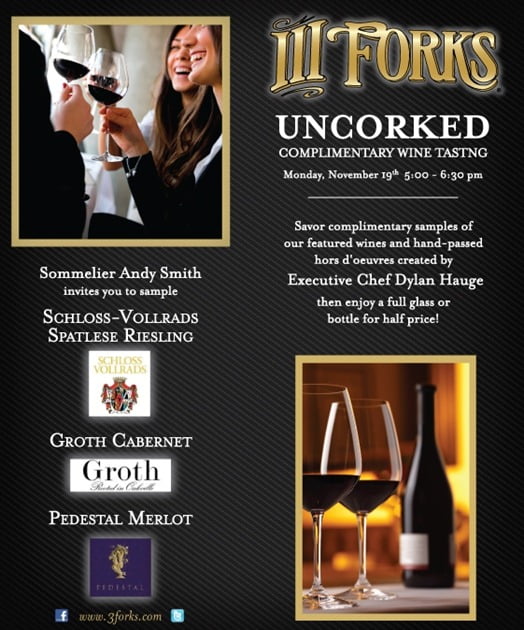
What I’ve Been Working On…
November 13, 2012 Have you noticed my posts have been a little “sporadic” lately?
”No…I haven’t actually.”
Well, you suck and you need to spend more time here then!
“Yes, I was wondering what all that was about!!! I’ve been tearing my hair out!!! What’s happening?!?!?”
Good to know you care! Don’t be concerned though! I’m not going anywhere…quite the opposite in fact!
Here’s what’s been occupying my time over the last few months:
Speaking Engagements
Early next year I’ve been asked to do a couple of fairly-major speaking gigs at the Eastern Winery Exposition and the Texas Wine and Grape Conference. My chosen topics will be social media, online strategy and mobile websites. Needless to say I’m equally psyched about both these conferences, and there are even a few more that are in the works which I haven’t confirmed yet. Once I have final approval on my press releases I’ll be posting more info here.
Mobile Website Design
This is probably where most of my time has been going! I’ve been designing mobile websites for quite a while now, but only recently decided to take the plunge and jump into it as a side-business.
The main website for my work can be found at www.mobilewinerywebsites.com. It isn’t just wineries who I deal with, but that’s where most of my focus lies. Needless to say if you’re looking for mobile compatibility for your website, without having to do a full redesign, you need to hit me up! ([email protected]).
ROKU Channel
This has also been a fairly large time-suck! If you don’t know what a ROKU is you should check it out! It basically enables you to stream select channels (600+), movies, music, games etc via a small box which is connected to the Internet into your house. You only pay a one-time fee (under $100), there are no other ongoing costs and you watch it direct on your TV.
I see such big potential in ROKU, that I decided to have my own custom channel built. The coding was just finished towards the end of last week, and now the only problem is that I’m working tirelessly to get all my videos uploaded!
If you have a ROKU account, you can login and add my channel by clicking here (just be aware that it’s still heavily under construction).
Wine Class
I’m currently teaching wine classes and front of house restaurant operations classes (around 23 hours a week) at the Jacksonville Art Institute. Bearing in mind that for the first few months of this year I was only teaching for 3 hours a week, my workload has been increased sizably! I’m not complaining though! I love what I’m doing, and maintaining the teaching gig helps me work on some of my other projects…where the paychecks are always more “intermittent.”
Competitions
I’ve been spending quite a bit of time working with my sponsors to try and get some giveaways in the lead up to the holidays. Starting next week I’m looking to have a minimum of 1 giveaway a week up-to Christmas, so stay tuned for more information on that. Make sure you’re connected on Facebook and/or my email newsletter so you hear about them first!
Posted in News | Tagged Kris Chislett | Leave a comment //← Older posts Newer posts →
-
Archives
- June 2014
- April 2014
- March 2014
- February 2014
- January 2014
- December 2013
- November 2013
- October 2013
- June 2013
- May 2013
- April 2013
- March 2013
- February 2013
- January 2013
- December 2012
- November 2012
- October 2012
- September 2012
- August 2012
- July 2012
- June 2012
- May 2012
- April 2012
- March 2012
- February 2012
- January 2012
- December 2011
- November 2011
- October 2011
- September 2011
- August 2011
- July 2011
- June 2011
- May 2011
- April 2011
- March 2011
- February 2011
- January 2011
- December 2010
- November 2010
- October 2010
-
Meta